

One investor, one $2 million sale, and eight free 1031 DST calculators that take him from selling his property to choosing his replacement investments.
Meet Tom
Tom is 62. Fourteen years ago he bought a fourplex for $900,000 with $300,000 down. He has fixed more water heaters than he can count, and he is done with 2 a.m. phone calls. A buyer has offered $2,000,000. Tom still owes $800,000 on the property. Tom isn’t a client of ours. He’s an example we use to walk through the numbers.
Tom wants to defer the tax bill, have the potential for income without managing tenants, and understand what he’s investing in. He is considering Delaware Statutory Trusts (DSTs), which let him own a share of professionally managed real estate. Here is how he worked through his exchange, one calculator at a time. (For simplicity, this example does not include selling costs.)
Step 1: What Is Tom Actually Working With?
Tom starts with the 1031 Property Sale Calculator. He enters what he paid, what he put down, the sale price and the loan balance.
It gives him the three numbers the rest of his exchange is built on: $1,200,000 of equity goes to his qualified intermediary (QI), $800,000 of debt is paid off, and his replacement property needs to total at least $2,000,000. Hold on to that $800,000. It matters more than most investors expect.
Step 2: What’s at Stake?
Next, the 1031 Tax Deferral Calculator. Tom adds the $365,000 of depreciation he has taken over the years.
That reduces his tax basis from $900,000 to $535,000. Subtracting that basis from his $2,000,000 sale price gives him a gain of $1,465,000. If he simply sold and kept the cash, the estimated federal bill would be:
- Depreciation-related gain at 25%: $91,250
- Capital gains at 20%: $220,000
- Net investment income tax at 3.8%: $55,670
Those three estimated federal taxes add up to $366,920—the amount Tom could potentially defer through a qualifying 1031 exchange. This example assumes his income makes the 25%, 20% and 3.8% rates apply as shown; actual rates depend on the investor’s tax circumstances. Tom lives in Texas, so there is no state income tax to add. In many states, the number would be higher.
Step 3: When Does the Clock Run Out?
Tom’s sale closes on November 13, 2026. The 1031 Deadline Calculator gives him two dates: he must identify his replacement DSTs by December 28, 2026, and close on them by May 12, 2027.
Then it flags something Tom would have missed. His 180th day falls after April 15, 2027, when his 2026 tax return is due. Unless he files an extension, his exchange has to be finished by the return’s due date, almost a month sooner. Tom makes a note to talk to his CPA about the extension.
Step 4: Does His List Pass?
Tom has narrowed his choices to five DSTs: an apartment DST, an industrial DST, a medical office DST, a self storage portfolio DST and a debt-free net lease DST. He enters them in the 1031 Identification Rules Checker with the real estate value of the interests he plans to identify, including his share of debt, $2,550,000 in total.
Surprise: the checker counts 16 properties, not 5. The self storage portfolio DST holds 12 properties, and each of the other four DSTs holds one. That rules out the 3-property rule. The good news: his list still passes the 200% rule, because $2,550,000 is under the $4,000,000 limit (twice his $2,000,000 sale), with $1,450,000 of room to spare.
Step 5: How Much Debt Does Tom Need?
Here’s the part that catches people. To defer all of the tax, Tom has to replace the equity and the debt. He paid off $800,000, so his DSTs need to carry at least $800,000 of debt, or he has to add cash of his own to cover the difference. Each DST comes with its own loan-to-value (LTV), so his share of the debt depends on which DSTs he chooses and how much goes into each.
At 62, Tom likes the idea of less debt. In the 1031 Leverage Calculator he tries a hypothetical 30% LTV instead of the 40% on the fourplex. The result: $285,714 of unreplaced debt, which may be treated as taxable boot unless he adds outside cash. Boot is value received in an exchange that may trigger tax. To replace the debt in full using only his exchange equity, his DSTs need a combined LTV of at least 40%.
Step 6: Which DSTs Fit?
Five DSTs, LTVs from 0% to 50%. Which combinations replace his debt? Tom puts his list into the 1031 DST Replacement Finder, splits his equity evenly across four DSTs, and lets it check every four-DST combination from the five he entered.
Only one equal-split combination fully replaces his debt: the apartment (50% LTV), industrial (45%), medical office (38%) and self storage portfolio (43%) DSTs, $300,000 each. Together they carry about $155,641 more debt than Tom paid off. The other combinations fall short. Tom has a workable starting point, but he wants to bring the extra borrowing down.
Step 7: Make It Exact
Tom clicks ↗ on that combination, and the 1031 DST Replacement Calculator opens with all four DSTs and their $300,000 amounts already filled in. The verdict reads Fully replaced. Extra debt doesn’t create boot by itself, but it does raise his leverage from 40.00% to 44.33%, and Tom would rather not take on more debt than he had.
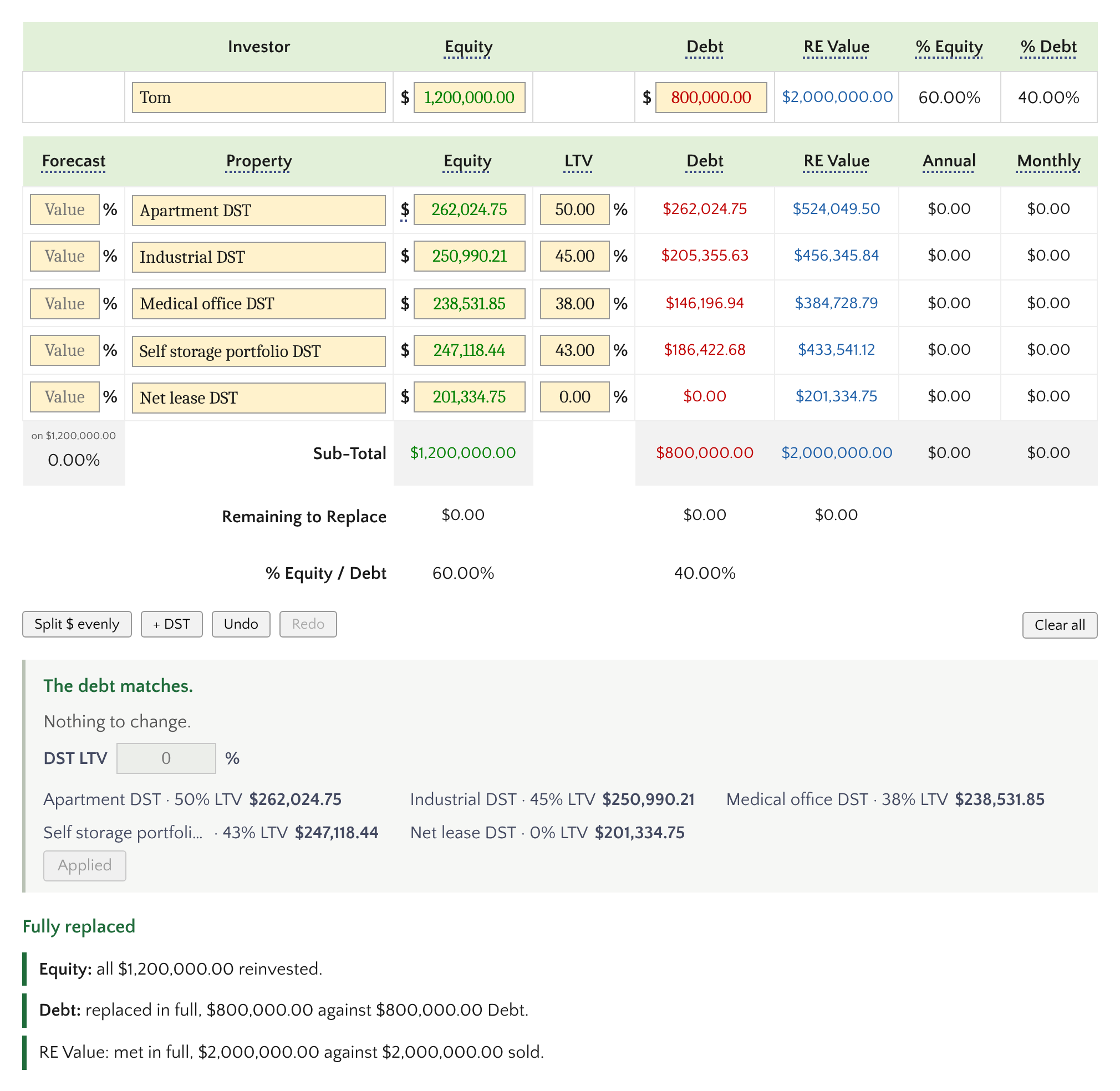
The Debt match check box under the buttons shows him how to match $800,000 to the penny: put part of his equity into a debt-free (0% LTV) DST and adjust the other four. His net lease DST is debt-free and already on his list. One click on Apply adds it as a Cash DST line, which Tom renames Net lease DST, and the worksheet reads:
- Apartment DST: $262,024.75
- Industrial DST: $250,990.21
- Medical office DST: $238,531.85
- Self storage portfolio DST: $247,118.44
- Net lease DST: $201,334.75
Equity $1,200,000, debt $800,000, real estate $2,000,000. All three replaced, nothing left over. If he changes his mind, Undo puts it all back. The calculator confirms the math, not the investments. Each DST’s property, sponsor, fees and risks still need review.
Step 8: What If Tom Keeps a Little Cash?
Tom’s grandson starts college next fall, and Tom wonders about keeping $50,000. The 1031 Boot Calculator answers in seconds: if he still replaces all $800,000 of debt, the $50,000 is taxable and the other $1,415,000 of his gain stays deferred.
The detail that surprises him: the calculator treats the $50,000 as depreciation-related gain in this example. Using the assumed 25% rate plus the 3.8% net investment income tax, the estimated federal cost is $14,400. Now Tom can discuss the choice with his CPA with a real number in front of him. For more on taking cash out, see Can You Take Cash Out of a 1031 Exchange?
Key Takeaways
- The debt you pay off must be replaced with debt or additional cash for full deferral, not just the equity.
- A DST that holds several properties counts as several identifications.
- Your tax return’s due date can come before your 180th day.
- Small changes in LTV move the debt by real dollars, so check the mix before you commit.
The Bottom Line
Tom ran all eight calculators in an afternoon, before his sale closed. Every one of them is free, with no registration, and works with DSTs from any source. Run your own numbers, or call us for help working through them.
Have questions about DST investments?
NexTrend Securities works with accredited investors, providing DST investment options as replacement property in a 1031 exchange.
Call NexTrend Securities at (972) 661-1283
This article is provided for general educational purposes only and does not constitute tax or investment advice. The scenario presented above is entirely hypothetical and is provided for illustrative purposes only. It does not represent the actual experience, performance, or portfolio of any specific investor or client of NexTrend Securities. DST investments involve risk, including illiquidity and potential loss of principal, and are suitable only for accredited investors. Tax treatment depends on individual circumstances. Consult your tax advisor regarding your individual situation. NexTrend Securities is not a tax advisor and does not provide tax advice.
We can help you make the most of your 1031 exchange.