

A 1031 DST from investment to sale.
A Delaware Statutory Trust can sound complicated at first. There is a sponsor, a trust, beneficial owners, a trustee, and often a master tenant and property manager. Fortunately, you do not need to become an expert in trust law to understand how the pieces fit together.
Start with the real estate.
A DST owns one or more properties. Investors purchase beneficial interests in the DST, while the sponsor and the other parties involved in the structure take care of the responsibilities assigned to them.
For a 1031 investor, the important point is that an interest in a properly structured DST can qualify as replacement real estate for a tax-deferred exchange under IRS Revenue Ruling 2004-86.
To make the structure easier to follow, imagine a DST that owns a $50 million, 300-unit apartment community. We will follow that same property from the investor’s purchase through its eventual sale.
Start With the Property
Instead of one investor purchasing the entire $50 million apartment community, a number of investors can invest different amounts in the same DST. One might invest $250,000, another $750,000 and another $1 million.
None of them individually owns Apartment 217, the clubhouse or a particular section of the parking lot. The DST owns the property, and each investor owns a beneficial interest in the DST.
That beneficial interest represents the investor’s proportionate share of the DST. Under Delaware law, the interest itself is considered personal property rather than ownership of a specific piece of the property.
For federal tax purposes, however, Revenue Ruling 2004-86 treats a qualifying DST interest as an interest in the underlying real estate. That is what allows it to be used as replacement property in a 1031 exchange.
The result is a structure that can give an investor access to a much larger real estate investment without having to purchase and manage an entire replacement property alone.
DST offerings are not available to all investors. They are Regulation D private placements, sold only to accredited investors and accredited entities. For an individual, that generally means a net worth over $1 million excluding a primary residence, or income over $200,000 individually or $300,000 jointly in each of the two most recent years, with the same expected this year.
The amount an investor puts in covers their share of expenses of acquiring the property and assembling the offering as well as the real estate itself, so the equity working in the property is less than the amount invested. There are costs while the property is held and when it is sold, and the fees and expenses for a particular DST are set out in its offering documents.
Who Puts the DST Together?
That begins with the DST sponsor.
The sponsor identifies the real estate, arranges for its acquisition, structures the offering and arranges financing when financing is used. It also establishes the entities and relationships needed for the DST to operate.
That is why an offering memorandum may contain several company names. In addition to the DST itself, you may see a trustee, trust manager, depositor, master tenant and property manager. Several of these entities may be created, controlled by or affiliated with the sponsor, with each performing a different role.
The trustee acts on behalf of the DST under the trust agreement, but its powers are deliberately limited. For example, the trustee generally cannot simply refinance the property, renegotiate leases or make major changes to the real estate as an individual owner might. The DST also cannot accept additional capital after the offering closes, and cannot refinance or renegotiate its loan if the property runs into trouble. Those restrictions help keep the DST a passive ownership structure for federal tax purposes.
You do not need to memorize an organizational chart to understand the investment. What matters is knowing who the sponsor is, what real estate the DST owns, who is responsible for operating it and how the important parties are related.
What Do You Actually Own?
You own a beneficial interest in the DST.
You do not receive a deed to a particular apartment or a specific portion of the property. Instead, your investment represents your proportionate interest in the DST. You are also a passive investor, so you do not take on the responsibilities of owning and managing the property yourself.
The simplest way to think about it is:
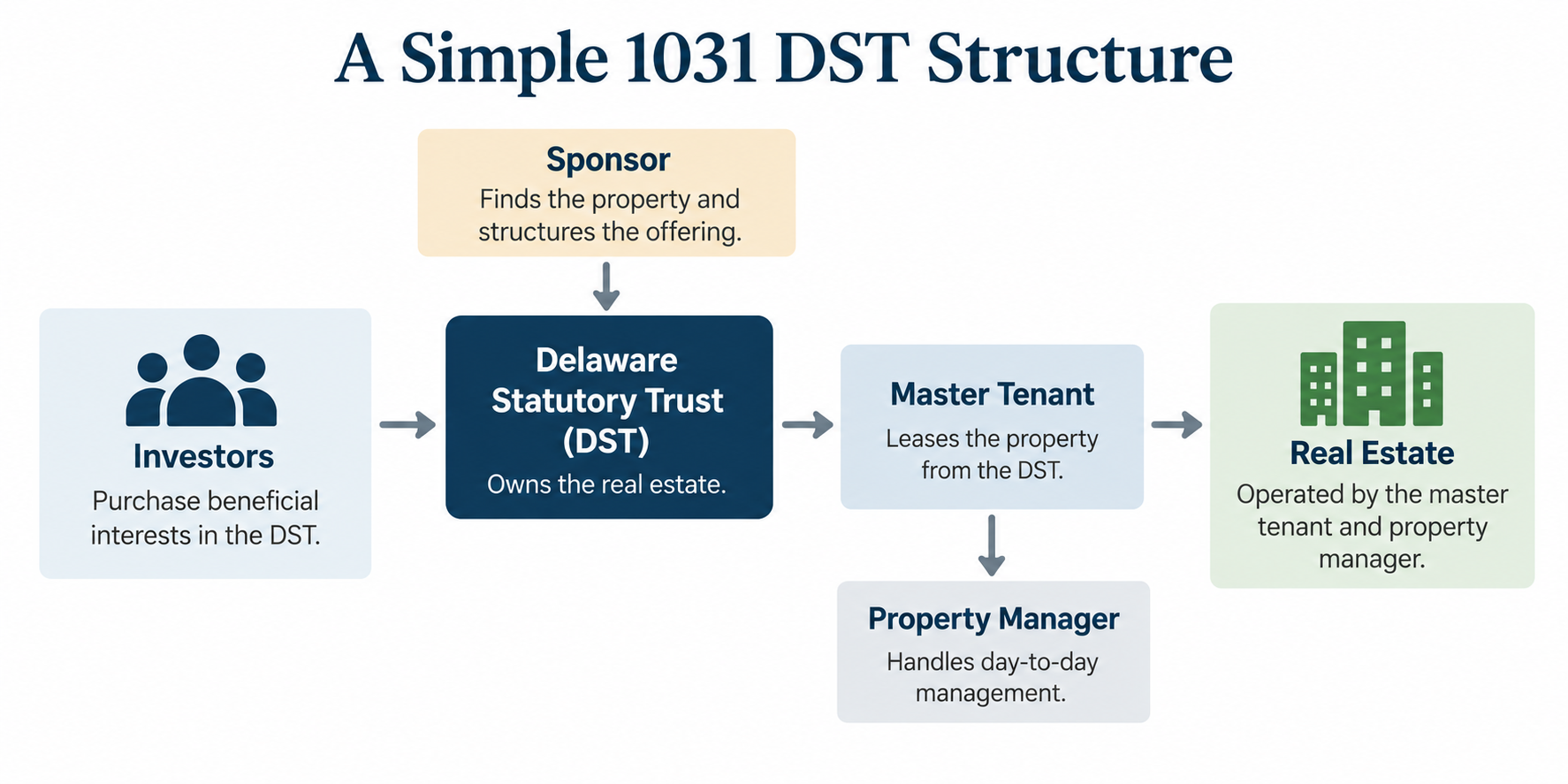
The DST owns the real estate. You own a beneficial interest in the DST. For federal tax purposes, a properly structured DST interest can qualify as replacement real estate for your 1031 exchange.
Who Runs the Property?
Our 300-unit apartment community still has to operate every day. Residents sign leases and pay rent. Units turn over. Repairs are made. Vendors have to be paid. Someone has to manage all of it.
The individual DST investors do not.
Many syndicated DST offerings use a master tenant structure. The DST leases the property to a master tenant, which is commonly an entity affiliated with the sponsor. The master tenant is responsible for operating the property under the master lease and may hire a professional property manager to handle the day-to-day work. This allows the property to be actively operated while the DST itself remains passive.
The distinction is fairly simple. The master tenant has the operating responsibility under the master lease; the property manager handles many of the day-to-day activities at the property.
In our apartment example, that may include leasing apartments, collecting rent, coordinating maintenance and keeping the property running.
The exact arrangement can vary by offering, so the offering documents identify the parties and their responsibilities for the particular DST you are considering.
How Does the Income Reach You?
It starts with the income generated by the property.
In our apartment example, residents pay rent. The property also has operating expenses and, if financing is used, loan payments. After expenses, loan payments, reserves and other obligations, available cash may be distributed by the DST to its investors according to the terms of the offering.
That is the important connection: your distribution ultimately comes from the underlying real estate.
If occupancy, rents or expenses change, the property’s performance can change as well. That can affect the distributions investors receive.
Distributions are not guaranteed. They can be reduced or suspended, and if the property does not perform as expected, an investor can receive less than the amount invested when it is sold. Where the DST uses financing, a loan default can result in the loss of the property and of the entire investment.
That is why we believe a DST should always be understood first as a real estate investment.
Who Makes the Decisions?
DST ownership is designed to be passive.
For an investor who has spent years dealing with tenants, repairs, lenders and property managers, that may be part of the attraction. The investor can continue to own an interest tied to real estate without personally running the property.
That also means the day-to-day decisions are handled for you. DST investors generally do not make operating decisions or decide individually when the property should be sold.
There is an important reason for this structure. The passive nature of a DST is an important part of how it is designed to work within the requirements of a 1031 exchange.
What If the Property Runs Into Trouble?
Real estate does not always perform as expected.
Many DST offerings allow the trust to be converted into a limited liability company, often called a springing LLC, if the property is in danger of being lost after a loan default. The conversion lets the new entity do what the trust cannot — renegotiate the loan, raise capital or sign new leases — and by itself it is generally not a taxable event.
But the converted entity is treated as a partnership for federal tax purposes, and a partnership interest is not like-kind property. An investor may no longer be able to continue into another 1031 exchange when the property is sold. There are ways to restore that option, but they generally require every investor to agree, and one who does not can end it for everyone.

What Happens When the Property Is Sold?
A DST is generally intended to be a long-term investment, but the property is not necessarily held indefinitely. Many DST offerings anticipate a holding period of several years, with seven to ten years being common. The actual timing of a sale can be shorter or longer and is not guaranteed.
The investor does not control that timing. A beneficial interest in a DST is illiquid. It is not listed or traded on a public securities market, and an investor who wants to exit before the property is sold may not be able to find a buyer at all. Any sale that does occur would be privately negotiated and could be at a substantial discount. A DST interest should be purchased with the expectation of holding it until the property is sold.
When the property is ultimately sold, the sale proceeds are used to pay off any remaining loan and other obligations of the DST. The remaining net proceeds are then distributed to the investors based on their ownership interests.
For a 1031 investor, the sale creates another decision. You can receive your proceeds and recognize any applicable taxes, or you may be able to begin another 1031 exchange and reinvest in a new DST or other eligible real estate.
Key Takeaways
- The DST owns the real estate; you own a beneficial interest in the DST.
- The sponsor puts the investment together, while the master tenant and property manager handle their respective roles in operating the property.
- DST investors are passive owners and generally do not make operating decisions or decide individually when the property will be sold.
- Distributions depend on the performance of the underlying real estate and are not guaranteed.
- A DST interest is illiquid and should generally be purchased with the expectation of holding it until the property is sold.
- When the property is sold, a 1031 investor may be able to begin another exchange rather than receive the proceeds and recognize the applicable taxes.
The Bottom Line
A 1031 DST may look complicated because several parties and entities can be involved.
Go back to our $50 million apartment community. The DST owns it, the sponsor put the investment together, the master tenant and property manager run it, and you own a beneficial interest as a passive investor.
That is the basic DST structure.
Understanding those relationships makes it much easier to understand what you are investing in, where your distributions come from, what you control and what happens when the property is eventually sold.
Have questions about DST investments?
NexTrend Securities works with accredited investors, providing DST investment options as replacement property in a 1031 exchange.
Call NexTrend Securities at (972) 661-1283
This article is provided for general educational purposes only and does not constitute tax, legal or investment advice. DST investments involve risk, including illiquidity and potential loss of principal, and are suitable only for accredited investors. The tax treatment of a 1031 exchange depends on your specific facts and circumstances. Consult your tax advisor regarding your individual situation.
We can help you make the most of your 1031 exchange.